
Artificial Intelligence (AI) is transforming businesses faster than ever before. In 2026, AI automation is no longer just an emerging technology—it has become a business necessity. Organizations across industries are using AI to automate repetitive tasks, improve decision-making, reduce operational costs, and enhance customer experiences.
Whether you are a startup, a small business, or a large enterprise, adopting AI automation can help you stay competitive in today’s digital world. From intelligent virtual assistants to predictive analytics and workflow automation, AI is reshaping the future of work.
In this blog, we will explore the top AI automation trends in 2026, their benefits, and how businesses can use these innovations to achieve long-term success.
What Is AI Automation?
AI automation is the process of using Artificial Intelligence technologies to perform tasks with minimal human intervention. Unlike traditional automation, AI systems can learn from data, recognize patterns, and make intelligent decisions.
Businesses use AI automation for:
- Customer support
- Data analysis
- Workflow automation
- Document processing
- Marketing automation
- Sales optimization
- Business intelligence
By reducing manual work, AI automation improves productivity, accuracy, and overall business performance.
Why AI Automation Is Important in 2026
Businesses are generating more data than ever before. Managing this data manually is time-consuming and inefficient. AI automation enables organizations to process information quickly, make informed decisions, and respond to customer needs more effectively.
Key benefits include:
- Increased productivity
- Reduced operational costs
- Improved decision-making
- Faster business processes
- Better customer experiences
- Higher accuracy
- Increased scalability
Organizations that embrace AI automation today are better positioned to adapt to future technological changes.
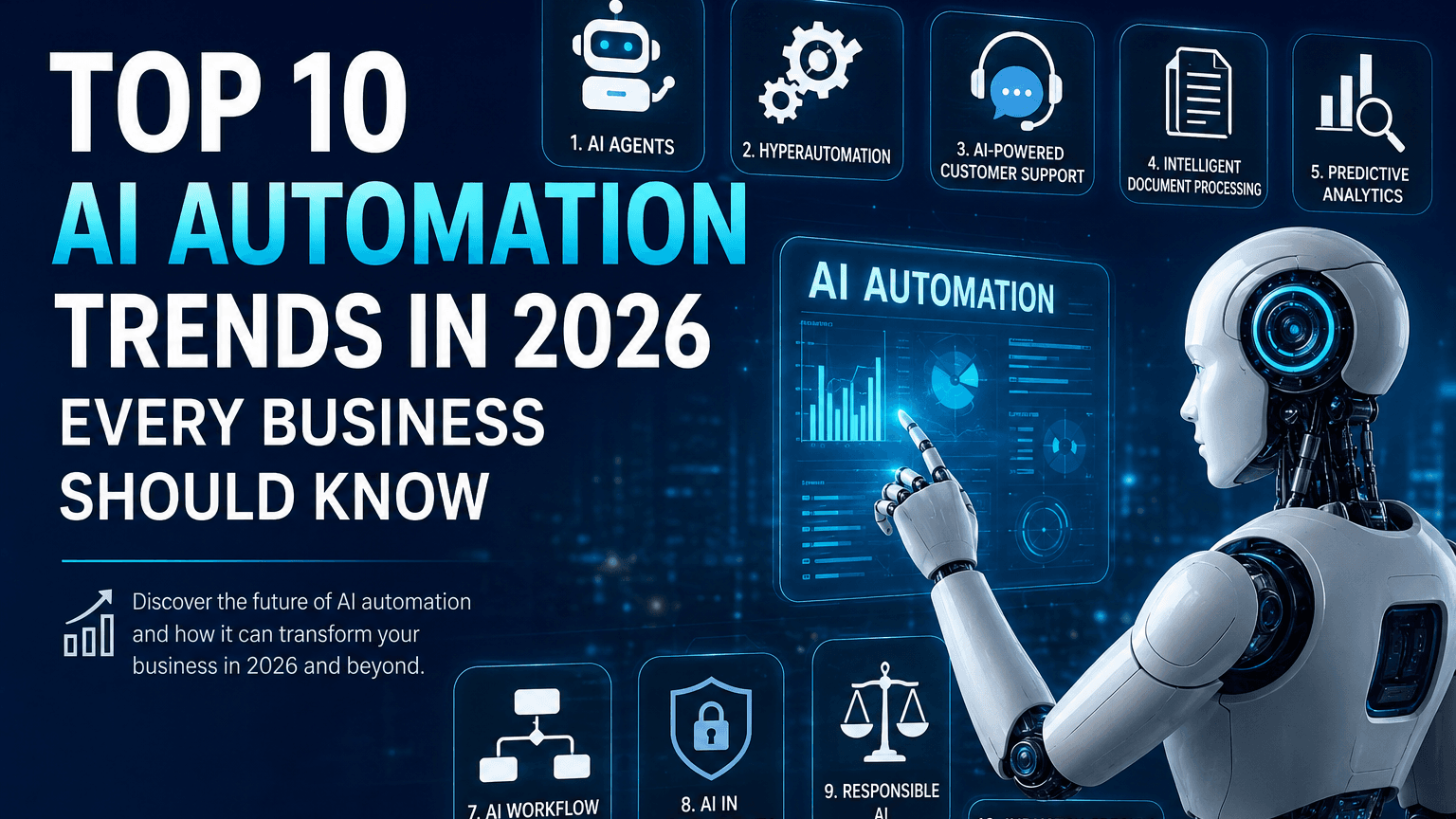
Top 10 AI Automation Trends in 2026
AI Agents
AI agents are becoming one of the most significant business technologies in 2026. Unlike traditional chatbots, AI agents can understand complex instructions, complete multi-step tasks, and interact with multiple business applications.
Common use cases include:
- Customer support
- Appointment scheduling
- Internal operations
- Task management
- Email automation
AI agents reduce manual effort while improving business efficiency.
Hyperautomation
Hyperautomation combines Artificial Intelligence (AI), Machine Learning (ML), and Robotic Process Automation (RPA) to automate complete business workflows.
Benefits include:
- Faster operations
- Lower business costs
- Reduced human error
- Better compliance
- Increased efficiency
Hyperautomation enables businesses to optimize both simple and complex processes.
AI-Powered Customer Support
Customer expectations continue to rise, making AI-powered support an essential business solution.
Modern AI systems can:
- Answer customer questions instantly
- Operate 24/7
- Route complex issues to human agents
- Provide personalized recommendations
- Support multiple languages
Businesses benefit from faster response times and improved customer satisfaction.
Intelligent Document Processing
Organizations process thousands of documents every month, including invoices, contracts, purchase orders, and reports.
AI can automatically:
- Read documents
- Extract important information
- Verify data
- Organize files
- Reduce paperwork
This improves efficiency while minimizing manual errors.
Predictive Analytics
Predictive analytics uses AI to analyze historical and real-time data to forecast future outcomes.
Businesses use predictive analytics for:
- Sales forecasting
- Customer behavior analysis
- Inventory management
- Demand forecasting
- Risk assessment
These insights help organizations make smarter business decisions.
Personalized Customer Experiences
Personalization has become one of the biggest competitive advantages.
AI helps businesses deliver:
- Personalized recommendations
- Targeted email campaigns
- Customized website content
- Smart product suggestions
- Personalized customer support
Better personalization increases customer engagement and loyalty.
AI Workflow Automation
AI workflow automation simplifies business operations by automatically managing repetitive processes.
Examples include:
- Task assignment
- Approval workflows
- Employee onboarding
- Invoice approvals
- Project tracking
Automation allows employees to focus on strategic work instead of repetitive tasks.
AI in Cybersecurity
Cyber threats continue to evolve every year.
AI strengthens cybersecurity by:
- Detecting unusual activities
- Monitoring networks continuously
- Identifying security threats
- Preventing fraud
- Responding to incidents faster
AI-powered security solutions help businesses protect valuable data and systems.
Responsible AI
Responsible AI focuses on developing and using AI systems ethically and securely.
Organizations are prioritizing:
- Data privacy
- Transparency
- Fair decision-making
- Regulatory compliance
- AI governance
Responsible AI builds trust with customers while reducing business risks.
Industry-Specific AI Solutions
Instead of using general AI tools, many businesses are adopting AI solutions designed specifically for their industries.
Examples include:
Healthcare
AI improves patient management, appointment scheduling, and medical data analysis.
Finance
Financial institutions use AI for fraud detection, risk assessment, and automated reporting.
Retail
Retail businesses leverage AI for inventory management, demand forecasting, and personalized shopping experiences.
Manufacturing
Manufacturers use AI for predictive maintenance, quality control, and production optimization.
Logistics
AI helps optimize delivery routes, warehouse operations, and supply chain management.
Education
Educational institutions use AI to personalize learning experiences and automate administrative tasks.
Industry-specific AI delivers greater efficiency and better business outcomes.
Benefits of AI Automation
Organizations implementing AI automation experience several advantages:
- Increased operational efficiency
- Lower operating costs
- Better customer service
- Improved business decisions
- Higher productivity
- Reduced manual work
- Enhanced scalability
- Greater competitive advantage
These benefits enable businesses to achieve sustainable growth.
Challenges of AI Automation
Despite its many advantages, businesses should also consider the following challenges:
Data Privacy
Organizations must protect sensitive customer and business data.
Implementation Costs
AI projects require investment in technology and skilled professionals.
Employee Training
Employees need training to effectively use AI-powered systems.
System Integration
Integrating AI with existing software can require careful planning.
Ethical Considerations
Businesses should ensure fairness, transparency, and accountability in AI decision-making.
Addressing these challenges helps maximize the value of AI investments.
How Businesses Can Get Started with AI Automation
Successful AI implementation begins with a clear strategy.
Follow these steps:
- Identify repetitive business processes.
- Define automation goals.
- Select the right AI solution.
- Start with a pilot project.
- Measure performance and results.
- Expand AI implementation gradually.
A structured approach increases the chances of long-term success.
Why Choose DeepITVision?
DeepITVision provides innovative AI and software development solutions designed to help businesses improve efficiency and accelerate digital transformation.
Our services include:
- AI Consulting
- AI Development
- AI Workflow Automation
- Business Process Automation
- Custom Software Development
- AI Integration
- Enterprise Software Solutions
Our experienced team works closely with businesses to deliver customized solutions that meet their unique goals and operational requirements.